.png)
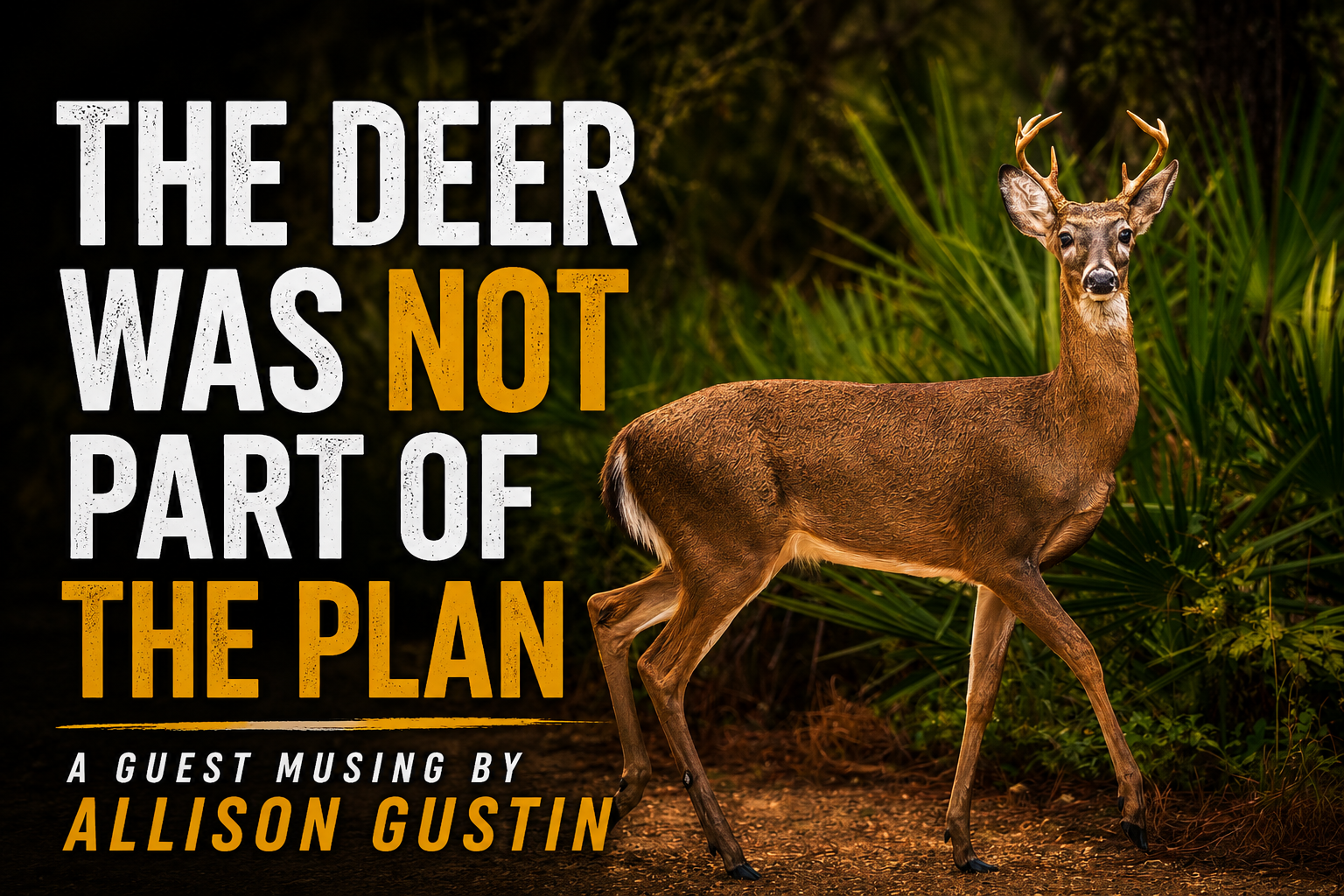


It turns out there’s a limit to what a person can calmly handle before dinner time.
Have you ever had one of those days where absolutely nothing goes according to plan?
Not catastrophically wrong. Just… relentlessly off.
The kind of day where you open the cereal box upside down, and now the bag won’t fit back into the cardboard, no matter how hard you try. Or you carefully prepare lunch for your child, only to discover that the strawberries touched the crackers, which means the entire plate has now become poisonous.
The kind of day where you get locked out of your email account, spend an hour trying everything you know to fix it, finally ask AI for help, and receive the deeply encouraging advice to “contact your administrator.”
Unfortunately, you are the administrator.
That kind of day.
The week my husband left for an international work trip, our basement flooring project — a project that had been moving at the speed of continental drift for nearly five years — suddenly decided this was the week to become urgent. At the same time, I was coordinating three children’s school and sports schedules, consulting work deadlines, my responsibilities as a Guide at my children’s school, and our ten-week-old Doberman puppy, Raya, who had recently entered what I can only describe as her Velociraptor Era.
Still, by Wednesday, I felt strangely optimistic.
I had systems.
Color-coded systems.
The kind of systems women create right before life humbles them.
We even had an entirely free evening ahead of us. No sports. No events. Four uninterrupted hours before bedtime.
I remember thinking, What are we even going to do with all this extra time?
Which, in hindsight, feels a little like a character in a movie saying, “It’s probably nothing.”
I was walking Raya through the yard while she practiced her favorite move — launching herself directly at my ankles with tiny razor teeth — when a buck exploded out of the brush.
If you’ve spent time around wildlife, you know how quickly a “beautiful nature moment” can turn into “this is how people end up on the local news.”
The deer slammed directly into our eight-foot fence, bounced backward, stumbled, then charged again. Raya froze. I froze. The deer finally cleared past us and disappeared into the woods.
My heart pounded so hard my fingers went numb.
I stood there for a second trying to regulate my breathing.
Whew. That was close.
Then I heard rustling again.
Another buck was lying in the grass nearby.
It lifted itself partially upright and looked at us, trembling. Then it collapsed back down.
Its back legs were broken.
Four days into solo parenting, I had reached the edge of my emotional bandwidth.
Immediately, my internal toddler surfaced.
This is unfair.
Why did this happen here?
Why this week?
Why is my husband asleep six time zones away while I’m apparently starring in Little House on the Prairie: Wildlife Edition?
I let myself have exactly ten seconds of self-pity.
Then I called the Indiana DNR.
An automated recording answered.
I listened to the two options it offered: cabin reservations and 2026 State Park Card information. I finally spoke desperately into the phone:
“There is a deer in my yard with broken legs, and I don’t know what to do.”
The system paused.
Then replied:
“Goodbye.”
Honestly, it felt personal.
So I called a local hunter, who kindly gave me the correct number. Within minutes, two officers were on their way.
And suddenly I found myself having conversations with my children I hadn’t planned on having that evening.
Because sometimes “helping” is not the kind of helping children imagine.
We waited inside while the officers handled what needed to be done. My children cried. I held them while they asked the kinds of enormous questions children only ask when your own heart already feels cracked open:
Where does it go after it dies?
Will it be alone?
Why does it have to die?
No parent ever feels fully prepared for those conversations.
Then we walked back outside, and one of the officers informed me that because the deer had died on our property, technically, the meat belonged to me.
Reader, I cannot explain to you how deeply I did not want to own this deer.
So I called every hunter I knew.
Every single freezer was full.
I love that for them.
The officers began working their way through the “deer list” — apparently a real list of people willing to claim venison donations. No takers.
Which left one remaining option: somehow transporting the deer a quarter mile to the road for pickup.
“Do you have a trailer?” one officer asked.
“No,” I answered immediately.
Because while many things are negotiable in life, one thing was certain:
That deer was absolutely not going in my minivan.
Meanwhile, my children stood beside me, clutching my hands, looking at me the way children do when they assume mothers know what to do.
And in that moment, I didn’t.
The officer looked at all of us standing there in the driveway and smiled gently.
“Well,” he said, “whatever you decide, we’re here to help.”
I will never forget those officers choosing to stay.
Not rushing off.
Not making me feel foolish.
Not treating me like an inconvenience.
Just… staying.
I made a mental note to process the emotion later. I had a deer to move.
But how?
Then I remembered the old red truck.
The one from the 1980s that starts approximately half the time and sounds like it has unresolved emotional issues.
Maybe tonight, I thought, it would rise to the occasion.
So I loaded the kids into the minivan and drove to the barn. I opened the garage door only to discover the truck bed already completely full of heavy equipment.
No space.
Of course.
And then — almost unbelievably — headlights appeared.
My neighbor drove up, pulling a trailer behind her Gator. She had noticed something was happening and came to help.
She saw a need… and just came.
Together, we got the deer to the road. Someone eventually arrived from the deer list to take the meat for their family. The officers stayed until everything was handled, just to make sure we were okay before they left.
And I’ve thought about that night a lot since then.
Our culture praises independence. Self-sufficiency. Holding it all together.
Sometimes growth looks less like strength and more like allowing yourself to be helped.
The “me” on the other side of this moment is stronger, steadier, and softer than the “me” in this moment, if I have the courage to see it through.
Sometimes God’s provision doesn’t look like removing the hard thing. Sometimes it looks like sending people willing to stand beside you in it.
And sometimes the miracle isn’t that everything worked out perfectly.
Sometimes the miracle is simply this:
When I ran out of answers, people stayed.
You're invited to subscribe to Ripples a soulful weekly newsletter crafted to nourish your inner knowing and spark meaningful insights. Each issue includes a short musing, reflection questions, and handpicked resources for your journey. If you're ready to reconnect, reflect, and rise in community with other spirit-led women, join us—and let the ripples begin.
Join my Ripples Newsletter
It’s been a hell of a day. I’m finally seventy miles in the air on a flight to D.C., then on to Indy — finally being the keyword.I’d spent the day in Savannah, Georgia, wrapping up a client’s strategic retreat. The plan was simple: finish by 4:30, get to the airport, and two-hop home to Indy by midnight. That was the plan — until it wasn’t.
Read this musing
Discover the hidden cost of “sacrifice syndrome” — the pattern of giving endlessly while neglecting yourself. Learn how renewal restores clarity, joy, and sustainable service.
Read this musing
As humans, we do these three things: We make up “stories” or versions of our truth using only our viewpoint and with limited and biased data. We assume our stories are factual, that we are right. We craft stories that put us in the best possible light. The stories don't always serve us - here is how to know!
Read this musing
Receive weekly insights from my years of lived experience as a creative, entrepreneurial woman stepping into my gifts and passions.
Join my Ripples Newsletter