.png)


My high school physics teacher’s voice rattled around in my head:
“An object in motion tends to stay in motion. An object at rest tends to stay at rest.”
In that moment, it felt less like a physics lesson and more like a description of my life.
After two grueling days in the airport—five canceled flights and finally getting home only by purchasing a last-minute ticket on a different airline—I was exhausted. Then came the final blow: during those long hours in the crowded terminal, the flu had found me.
A light schedule allowed me to sleep for nearly 36 hours straight. Outside, snow fell and arctic temperatures settled in. Curling up on the couch with a blanket and a book felt like the most reasonable choice in the world.
I followed the advice we all know so well: stay inside, stay warm, rest.
Afternoon naps stretched into evening naps. Lazy days blurred together. Even after the flu began to fade, my pace barely changed. I would work for a few hours and then collapse back into bed. Another nap. Another slow afternoon.
Day after day passed like this until nearly a week had gone by.
I knew I couldn’t remain in this suspended animation forever. Soon there would be places to go and people counting on me. But the longer I stayed still, the harder it became to move.
My mind knew I needed to break the cycle. My body, however, was quite content to remain exactly where it was.
Finally, using every ounce of willpower I could gather, I bundled up—boots, scarf, gloves, my warmest coat—and stepped outside for a walk.
Even then, the voice in my head whispered excuses.
It’s too cold.
You’re not fully over the flu.
You can skip it today.
Fortunately, another voice answered back.
You’re dressed warmly.
You’ll feel better once you move.
Just start.
It turns out that voice was right.
As I walked, I began thinking about inertia and how it works in both directions.
During that week of rest, it had been surprisingly difficult to start moving again. Yet I could easily recall other periods of my life when the opposite had been true—when activity had built so much momentum that slowing down felt almost impossible.
I think back to the years when I was raising school-aged children while working full-time and attending graduate school part-time. I can still feel the bone-deep exhaustion of that time.
There was always something that needed to be done. Homework assignments due at midnight. Kids who needed me. A job that required my full attention during the day.
Even when I was exhausted or sick, I kept going. I stayed up late to finish assignments. I rushed from one obligation to the next. Every hour was accounted for. There was a schedule, a plan, a set of expectations that had to be met—no matter how depleted I felt.
Halfway through that five-year journey toward my master’s degree, I remember breaking down in tears. They weren’t tears of relief for reaching the halfway mark. They were tears of despair.
Five more semesters. Five more semesters of running at this pace. I knew it wasn’t sustainable. But I also felt like I couldn’t stop.
In periods of relentless activity, momentum can become so strong that our own wisdom struggles to interrupt it. Deep down, we know we are pushing too hard. We recognize the warning signs.
Yet we keep going.
Often, what finally breaks the cycle is not a conscious decision but a physical one. Illness. Exhaustion. Burnout. The body intervenes when the mind refuses to listen.
Ironically, the same dynamic can happen on the other end of the spectrum. When we’ve been still for too long—resting, recovering, or simply drifting—it can become surprisingly hard to reengage with life.
This realization led me to reconsider a phrase we hear constantly: work–life balance.
From my experience, balance suggests something unrealistic—a single perfect point where everything aligns. A place where activity and rest exist in perfect proportion.
But life rarely works that way.
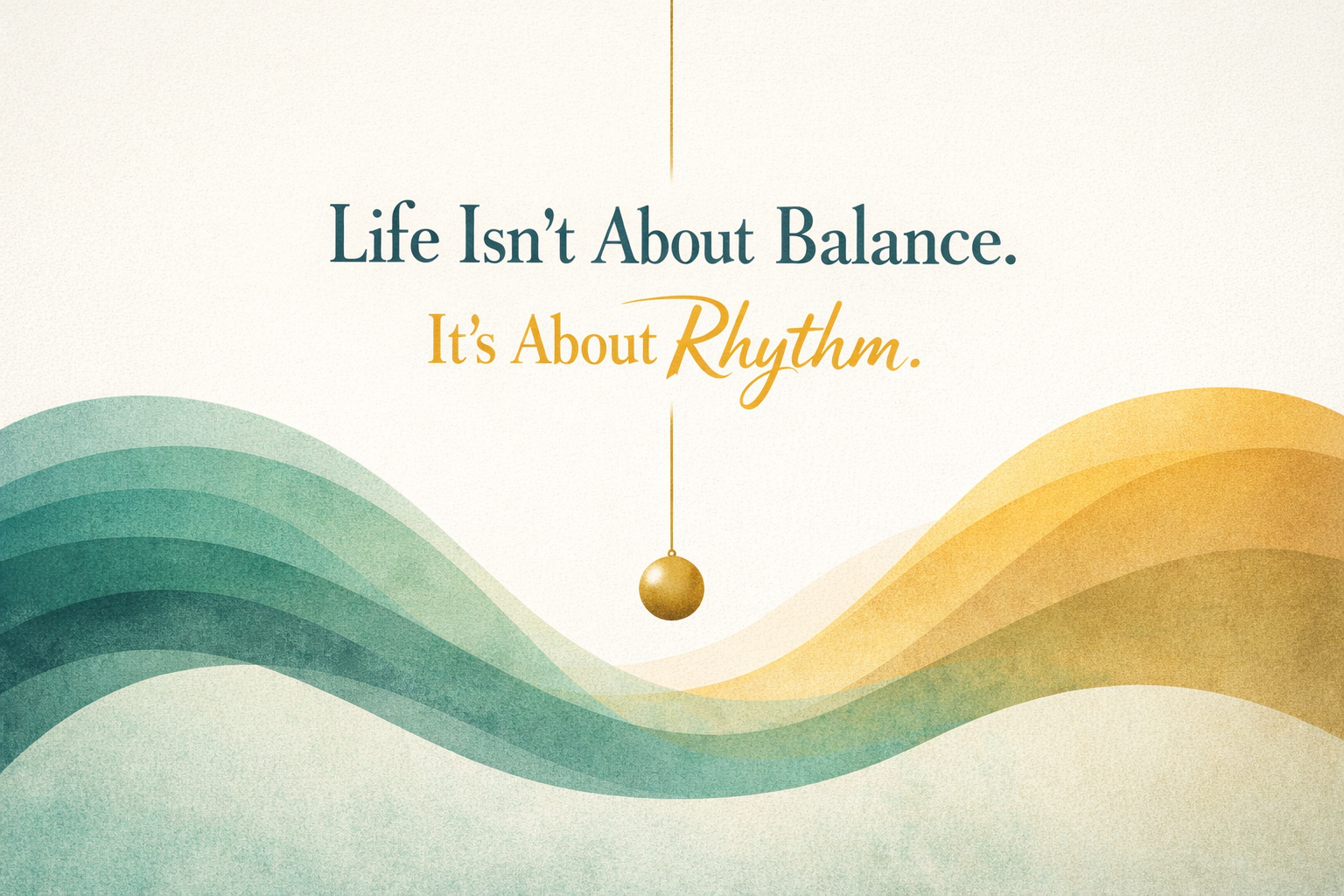
A better metaphor might be equilibrium—a dynamic movement between effort and recovery.
Think of the tides moving in and out. Or a pendulum swinging gently back and forth. Our lives naturally move between periods of activity and periods of rest.
At its healthiest, this rhythm is fluid and responsive. We move into activity when energy and circumstances call for it. Then we return to rest so that energy can be restored.
The problem arises when we get stuck at either extreme. Too much activity eventually leads to exhaustion. Too much rest can slide into stagnation.
Neither extreme is sustainable.
The idea of balance implies a tiny, precarious point—something difficult to find and even harder to maintain.
Anyone who has attempted a balance pose in yoga knows this feeling well. For a brief moment, you may find the exact center point. But almost immediately, the body begins to wobble. You adjust, correct, and try again.

Balance, it turns out, is fleeting.
But equilibrium offers something different: a wider optimal zone.
Instead of a single point, imagine a range—a place where you have enough rest to restore your energy and enough activity to engage meaningfully with life.
Within this range, small adjustments keep you moving toward center.

Sometimes your life will tilt more toward activity. A demanding work project. A busy season of parenting. A creative endeavor that requires long hours.
Other times it will tilt toward rest. Recovering from illness. Grieving a loss. Taking time away on vacation.
Both are natural. Both are necessary.
The challenge is learning to recognize when we’ve drifted too far from the center.
Our bodies are remarkably good at telling us when something needs to change—if we’re willing to listen.
When activity dominates for too long, the signals may appear as:
• persistent fatigue
• irritability or overwhelm
• difficulty sleeping
• frequent illness
When rest stretches too far into inertia, the signals may look different:
• lethargy
• lack of motivation
• avoidance of simple tasks
• a sense of heaviness or disconnection
These signals are not failures. They are course corrections.
What fascinates me most is how small actions can reverse momentum.
When we’re lonely, a brief conversation or even a smile to a stranger can begin to shift something inside us.
When we’re lethargic, a ten-minute walk can awaken energy we didn’t know was still there.
When we’re overwhelmed, pausing for ten deep breaths can interrupt the stress cycle.
These actions rarely solve the underlying problem immediately. But they do something just as important.
They create movement. One small shift leads to another. Awareness grows. The pattern begins to change. Slowly, the ship rights itself.
As I write this, my mind goes back to wisdom from my running coach. Our running group had traveled to San Diego for the race. We had trained for months, but the night before the event we faced a problem: the time change meant we would get very little sleep before our 4 a.m. wake-up call.
As we crowded around in his hotel room the night before the race, he reassured us.
“One night of poor sleep,” he said, “won’t undo months of training.”
And he was right. We ran the race. We finished strong.
That experience taught me something important about energy. Short-term depletion is different from long-term exhaustion.
One empty tank can be refilled. But if we ignore the signals for too long, we risk running completely out of fuel.
Life will always pull us in different directions. There will be seasons of intense activity and seasons that invite rest. Neither state is permanent, and neither is inherently wrong.
What matters is our ability to notice when we’ve drifted too far—and to gently guide ourselves back toward center.
Often, the hardest step is also the smallest one.
Putting on your shoes and stepping outside.
Taking a deep breath.
Saying no when you would normally say yes.
Or saying yes to something that invites you back into motion.
In the end, equilibrium isn’t about perfect balance.
It’s about learning how to shift momentum—again and again—until we find ourselves moving within that wide, sustaining range where life can flow.
Sometimes, small course corrections are enough to help us return to a healthier rhythm. But if you find yourself stuck for long periods—either unable to slow down or unable to get moving—reaching out for support may help.
In the United States, two places to start are:
988 Suicide & Crisis Lifeline
Call or text 988 to connect with trained counselors who provide free, confidential support 24/7. You do not need to be suicidal to reach out; people contact the line for anxiety, overwhelm, loneliness, and emotional distress.
A healthcare provider or therapist
A primary care provider or licensed therapist can help determine whether exhaustion, burnout, depression, anxiety, or physical health issues may be contributing to how you feel.
Seeking help is not a sign of weakness. It is simply another way of shifting momentum—one step that can help guide you back toward steadier ground.
You're invited to subscribe to Ripples a soulful weekly newsletter crafted to nourish your inner knowing and spark meaningful insights. Each issue includes a short musing, reflection questions, and handpicked resources for your journey. If you're ready to reconnect, reflect, and rise in community with other spirit-led women, join us—and let the ripples begin.
Join my Ripples Newsletter
It’s been a hell of a day. I’m finally seventy miles in the air on a flight to D.C., then on to Indy — finally being the keyword.I’d spent the day in Savannah, Georgia, wrapping up a client’s strategic retreat. The plan was simple: finish by 4:30, get to the airport, and two-hop home to Indy by midnight. That was the plan — until it wasn’t.
Read this musing
It’s Monday morning. 7 a.m. I sit at the kitchen table, gazing out at the dawn. It’s not quite light, but no longer dark. This in-between moment holds both the arrival of light and the retreat of night. And later, as the day dims into dusk, the cycle will reverse. This liminal time feels like a perfect metaphor for the emotions surrounding me lately. A reminder that opposites often co-exist — joy and despair, hope and fear, sadness and light. One woven into the other. One fades so the other may rise.
Read this musing.png)
A purely destination-driven life becomes transactional: work hard, defer joy, stay focused. A purely meandering life risks stagnation or circular wandering. But together? You aim toward something while allowing yourself to evolve along the way.
Read this musing
Receive weekly insights from my years of lived experience as a creative, entrepreneurial woman stepping into my gifts and passions.
Join my Ripples Newsletter